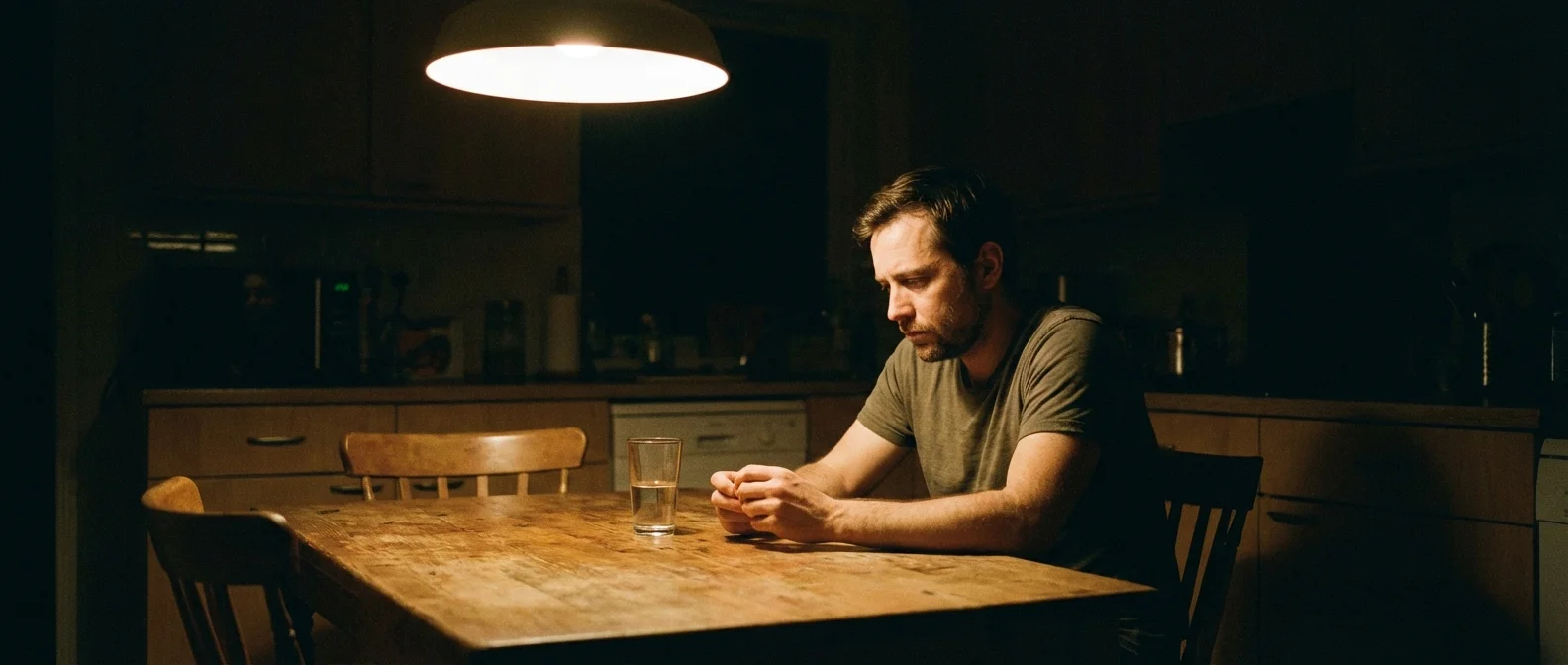
You did the hard thing. You stopped drinking. You expected relief, clarity, maybe even some version of a fresh start.
Instead, you feel worse. More anxious. More angry. More alone than when you were three beers deep on the couch.
If you're wondering why sobriety feels worse before it feels better, you're not broken. You're not doing it wrong. What's happening to you right now is one of the most predictable and least talked about parts of getting sober.
Here's what's actually going on.
Yes, it's normal to feel worse in recovery before you feel better. Your brain is recalibrating its chemistry after years of alcohol overriding its reward system. At the same time, every emotion you numbed is resurfacing at once. And underneath all of it, you're facing an identity crisis: who are you without the drink? This article walks through what's happening, why it matters, and how to get through it.
Why your brain feels worse after getting sober
Alcohol hijacks your brain's reward system. Every drink floods your system with dopamine, the chemical that makes you feel good. Over time, your brain compensates. It dials down its own dopamine production because the alcohol is doing the job.
When you stop drinking, that external supply disappears. But your brain hasn't caught up yet. It's still producing less dopamine than it should. The result: everything feels flat, joyless, and gray. The things that used to make you feel something, food, music, conversation, don't land the same way.
This is called anhedonia. It's not a character flaw. It's brain chemistry. And it takes time to correct. Research suggests dopamine receptors need four to six months to normalize after heavy drinking.
Then there's Post-Acute Withdrawal Syndrome (PAWS). Most people know about the first week of physical withdrawal: sweating, shaking, insomnia. But PAWS is the second wave. Weeks or months after the physical symptoms pass, you get hit with anxiety, mood swings, irritability, and depression that seem to come from nowhere. PAWS can last six to 18 months in some cases.
Knowing this helps. You're not going backward. Your brain is rebuilding a system that was overridden for years. That rebuild takes time.
Why emotions in early sobriety hit all at once
Here's what nobody tells you: alcohol doesn't just numb bad feelings. It numbs all feelings. When you take that lid off, everything you've been suppressing comes flooding back at once.
Guilt about things you said. Shame about things you did. Grief about relationships you damaged. Anger you never let yourself feel. Sadness you didn't know was there.
It's not that sobriety created these feelings. They were always there. Alcohol was the wall between you and them. Now the wall is gone.
I see this pattern constantly in my practice. Men who were managing fine on the surface for years. They were performing, compartmentalizing, keeping it together. Then they make one honest change, like cutting out alcohol, and the whole structure shifts. Everything they were avoiding starts demanding attention.
This is the emotional rollercoaster of early sobriety. Not because something is wrong, but because something is finally right. The flood of emotions in early sobriety is your system catching up on years of deferred processing. You're feeling what you were supposed to feel all along.
Sober but miserable: the identity crisis nobody talks about
This is the part most articles skip, and it's the part that matters most.
Alcohol wasn't just a drink for you. It was a social identity. A stress response. A way to bond with friends, decompress after work, celebrate, mourn, and fill quiet evenings. It was woven into how you showed up in the world.
When you remove it, you don't just lose a habit. You lose a version of yourself. That's why so many men end up sober but miserable, wondering if they made the right call.
"Who am I without this?" That question sits underneath the depression, the irritability, the boredom. It's the real question.
For men, this hits differently. Drinking culture is deeply tied to how men connect. The after-work beers. The watching-the-game ritual. The "let's grab a drink" as shorthand for every social interaction. When you stop drinking, you don't just lose a coping tool. You lose your social operating system.
Suddenly, you don't know how to relax. You don't know how to be around your friends. You don't know what to do with a Saturday night. The boredom isn't just boredom. It's an identity vacuum.
This is where most people panic. They think something is wrong with sobriety. Nothing is wrong with sobriety. Something is being revealed about how much of their life was organized around a substance.
Why the pain is actually the work
Here's where I'm going to push you a little.
The discomfort you're feeling right now is not a problem to solve. It's the beginning of something important.
Gabor Mate, a physician who spent decades working with addiction, describes it like this: addiction is not about the substance. It's about disconnection from yourself. The substance fills a gap, numbs a wound, creates distance between you and something you don't want to face.
When you take away the substance, that gap opens back up. And what rushes in is everything you've been avoiding: old pain, unprocessed grief, parts of yourself you disowned years ago.
Psychologically, this is what happens when the parts of yourself you've pushed away finally come back into view. Anger. Vulnerability. Need. Fear. These parts don't disappear when you suppress them. They run your life from the background until something forces you to face them.
Alcohol kept the shadow quiet. Sobriety let it speak.
This is why early sobriety depression is so disorienting. It's not just chemical. It's existential. You're not just detoxing from a substance. You're meeting parts of yourself you've spent years avoiding.
You're not broken. You're fragmented. The parts of yourself you disowned are finally surfacing. That's not a crisis. It's the first honest thing that's happened in a long time.
The feelings aren't the problem. The years of avoiding them was the problem. Sitting with them now, as uncomfortable as it is, is what integration looks like. Messy. Raw. Real.
When does sobriety get easier? A realistic timeline
Let's be specific about what to expect, because vague reassurance doesn't help.
Weeks 1-2: Physical withdrawal peaks and fades. Sleep is terrible. Anxiety is high. Some people experience a "pink cloud," a brief rush of euphoria from the decision to quit. Don't trust it. It passes.
Month 1: The pink cloud crashes. Depression, irritability, and mood swings after quitting alcohol set in hard. This is where most people start questioning if sobriety is worth it. It is. You just can't see it yet.
Months 2-3: Boredom becomes the main enemy. Not just regular boredom. Existential boredom. The kind where you realize how much of your free time was organized around drinking. Grief shows up here too, for lost time, damaged relationships, the person you could have been.
Months 3-6: Emotions start to stabilize, but they come in waves. Good weeks followed by bad days. Relationships may get harder before they get better. The people around you are watching and waiting. They've heard you say "I'm done" before. Trust takes time to rebuild.
According to the University of Nebraska Medical Center, one in three people in early sobriety can't escape anxiety and depression without targeted help. This isn't weakness. It's a signal that sobriety alone isn't enough. You need to do the work underneath.

How to get through a Tuesday night
The big advice everyone gives, "get a therapist," "join a support group," is fine. But it doesn't help you at 8 p.m. on a random Tuesday when you're alone and the silence is louder than it's ever been.
Here are things that actually work in those moments:
Move your body. Not to "get healthy." To burn off the restless energy that used to get channeled into drinking. A 20-minute walk. Push-ups until your arms shake. BJJ, boxing, running. Whatever gets you out of your head and into your body.
Name what you feel. Out loud if you need to. "I'm angry right now." "I'm lonely." "I'm scared this is all there is." It sounds simple, but most men have never done this. You spent years numbing instead of naming. Naming is the first step toward owning your emotions instead of being run by them.
Write it down. Not a journal entry for posterity. Just a brain dump. What's bugging you? What are you avoiding? What pattern are you noticing? Getting thoughts out of your head and onto paper takes away some of their power.
Rebuild your social life on purpose. Don't wait for it to happen. The old social life was built around alcohol. The new one needs to be built around something else. Find one person you can be honest with. One activity that doesn't involve a bar. Start there.
Know when you need more help. If you're having thoughts of self-harm, if the depression doesn't lift after weeks, if you feel yourself heading toward relapse, call someone. The 988 Suicide and Crisis Lifeline is available 24/7. This isn't about being strong enough to do it alone. It's about being honest enough to know when you can't.
It gets better, but not the way you think
Everyone wants to hear "it gets better." And it does. But not the way you're imagining.
It doesn't go back to how things were before the drinking. That version of you is gone. What happens instead is you become someone new. Someone more honest. More grounded. More present.
The goal isn't comfort. It's wholeness. It's becoming the same man everywhere, at work, at home, alone, with friends, instead of performing different versions depending on the context.
The man on the other side of this is someone you haven't met yet. He's built on everything you're going through right now, the discomfort, the grief, the raw honesty of early sobriety.
That man is worth the Tuesday nights. Worth the boredom. Worth the pain that comes before the clarity.
You did the hard thing by stopping. Now comes the harder thing: staying with what comes up when you do.
That's the real work. And it's the only work that lasts.
If you came here wondering why sobriety feels worse before it feels better, now you know. It's not a sign you failed. It's a sign you started.
This article is not a substitute for medical advice, therapy, or addiction treatment. If you are experiencing severe depression, suicidal thoughts, or substance withdrawal, please contact the 988 Suicide and Crisis Lifeline (call or text 988) or reach out to a medical professional. Coaching supports personal growth and pattern change. It does not replace clinical care.